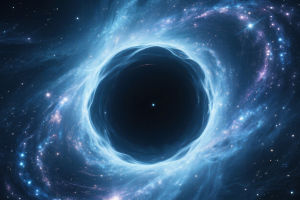
A black hole is a region of space where gravity is so extreme that nothing — not matter, not light — can escape.
Not because of some exotic science-fiction force, but because of the same gravitational physics that holds planets in orbit, just pushed to an extreme that warps space itself.
They're real, well-documented, and in 2019 a global network of radio telescopes captured the first direct image of one.
How a Black Hole Forms
Most black holes begin as massive stars — objects many times heavier than our Sun. When a star exhausts its nuclear fuel, it can no longer generate the outward pressure that counterbalances gravity. The core collapses violently. In some cases, this triggers a supernova, blasting the outer layers into space.
If enough mass remains in the collapsing core, no force in nature can stop the collapse. A black hole is what's left. The resulting objects range from a few times the Sun's mass up to roughly 40 solar masses, depending on the original star. At the other end of the size spectrum, supermassive black holes — containing millions to billions of solar masses — sit at the center of nearly every large galaxy, including our own Milky Way.
The Event Horizon and the Singularity
A black hole has two defining structural features. The event horizon is a spherical boundary — a point of no return. Anything crossing inward cannot come back out, because doing so would require traveling faster than light. The event horizon isn't a solid surface.
It's more like a threshold in space, invisible and passable in principle, after which all paths lead only inward. Its size depends on mass: a black hole with the same mass as our Sun would have an event horizon radius of about 2.9 kilometers. The boundary is named the Schwarzschild radius after the physicist who first calculated it.
At the very center lies the singularity — a point where, according to general relativity, matter is compressed to zero volume and infinite density. This is where the math of current physics breaks down. General relativity predicts the singularity must exist, but most physicists believe a more complete theory of physics, one that reconciles gravity with quantum mechanics, will eventually replace this picture with something less extreme.
What Surrounds a Black Hole
A black hole in isolation is invisible. What makes them detectable is the material spiraling around them. Gas and dust pulled toward a black hole form an accretion disk: a superheated, rapidly rotating structure that radiates intensely as material spirals inward.
Temperatures in the disk can reach millions of degrees. The black hole's gravity also bends nearby light so severely that light from the accretion disk follows curved paths, appearing to wrap over and under the black hole in a distorted shape — gravitational lensing.
In the first EHT image of M87's central black hole, the ring of light surrounding the dark shadow is the glowing disk, with uneven brightness caused by the material rotating at close to the speed of light.
What Happens if Something Falls In
The experience depends entirely on the black hole's size. The critical factor is tidal force — the difference in gravitational pull between two points on a falling object. Near a stellar-mass black hole, tidal forces become lethal long before the event horizon: the difference in pull between a person's head and feet would be extreme enough to stretch and compress the body, a process physicists call spaghettification.
Near a supermassive black hole, the event horizon is so large that the tidal forces at the boundary are surprisingly gentle — you could cross it without feeling anything unusual. The destruction comes later, deeper in.
Hawking Radiation and an Unsolved Puzzle
Stephen Hawking proposed in the 1970s that black holes aren't perfectly permanent. Quantum effects near the event horizon cause pairs of particles to form spontaneously — one falls inward, one escapes outward as thermal radiation. This Hawking radiation carries energy away from the black hole, meaning it very slowly loses mass over time.
For stellar-mass black holes, this process is unimaginably slow — the timescale for complete evaporation far exceeds the current age of the universe.
Hawking radiation has never been directly detected, but it raises one of the deepest open questions in physics: if a black hole evaporates completely, what happens to all the information about everything that fell in? That question, the black hole information paradox, remains unsolved.
Every black hole is a question mark wrapped in gravity. We now know how they form, what surrounds them, and what crossing the event horizon might feel like. But what happens to information inside? And what replaces the singularity? Those answers will come from a deeper theory – one we haven't written yet.